Historical success for animal-free pyrogen testing
- Press release
Important steps toward ending the suffering of horseshoe crabs
A significant milestone in the history of drug safety: Organized by the European Council and representatives of the European Commission and industry, the 'Pyrogen Testing 2.0' symposium took place in Brussels on February 25 and 26, 2026. The focus was on the final departure from cruel animal testing when screening for fever-inducing substances (pyrogens).
Since January 1, 2026, the Rabbit Pyrogen Test (RPT) has been officially removed from the European Pharmacopoeia (Ph. Eur.). This deletion ends a 55-year era in which this procedure served as the standard for testing for fever-inducing substances. In this test, rabbits were restrained in narrow boxes for hours to have test substances injected into their ear veins while their temperature rise was measured. Thanks to persistent lobbying by animal welfare groups, the number of rabbits used for these tests had already fallen by 49% between 2015 and 2020. The Monocyte Activation Test (MAT), which uses human blood cells and provides significantly more precise results, now serves as the primary modern, animal-free method. Its removal from the European Pharmacopoeia means that the test is no longer officially accepted for pyrogen testing within the EU.
Another major success concerns the protection of horseshoe crabs. For the so-called LAL (Limulus Amoebocyte Lysate) test, these prehistoric animals are ‘tapped’ alive to extract their blue blood. We at the European Coalition to End Animal Experiments (ECEAE) only recently submitted around 34,000 collected signatures to the European Medicines Agency (EMA) in December 2025. Our campaign calling for an end of the LAL test is having an impact. The synthetic, animal-free alternative ‘Recombinant Factor C’ (rFC) is now firmly anchored in the Pharmacopoeia as an official method (Method G). Starting January 1, 2027, companies will no longer have to laboriously prove that the animal-free test delivers the same results as the animal-based version, which represents an enormous bureaucratic relief for the transition. The EMA now explicitly recommends that manufacturers move away from the LAL test and instead use modern animal-free testing methods.
"It is gratifying to see that an awareness of the need to abolish the LAL test has developed within both industry and EU institutions. The will to switch is there, and the path has been cleared," says our Chair, Dr. Tamara Zietek, who attended the symposium in Brussels on behalf of the ECEAE. "It is now important that both industry and authorities establish animal-free testing in practice so that the cruel LAL test is also removed from the European Pharmacopoeia".
Although Europe serves as a role model here, the lack of global harmonization remains an obstacle to the complete elimination of animal-based pyrogen testing. As long as other countries still mandate animal testing, companies must continue to torture rabbits for export products. "This symposium proves: Science is ready, and the authorities are finally slowly following suit," Zietek explains. "We now call on all international authorities to follow the European example and finally end the bleeding of crabs and the suffering of rabbits worldwide".
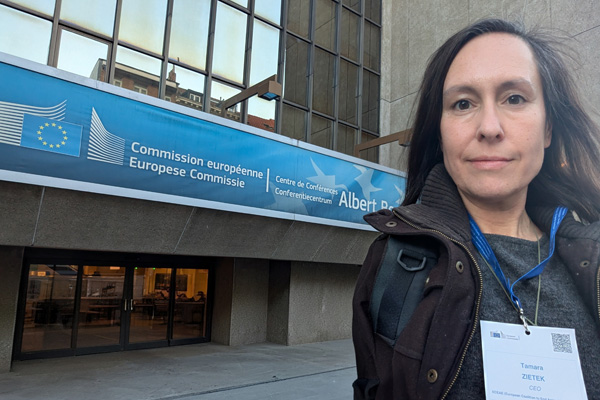
ECEAE Chair Dr. Tamara Zietek at the EDQM Symposium 'Pyrogen Testing 2.0' in Brussels.